

The Museum of Special Education in Levoča, a specialized museum with nationwide coverage, with comprehensive documentation in the field of special education, special pedagogy, and education of students with disabilities, creates a space for introducing significant figures in special education and pedagogy in Slovakia.
One of them is Associate Professor PhDr. Vladimír Predmerský, CSc., left an incredible legacy and, in particular, an indelible mark with a lion’s share in creating the system of special schools for students with mental disabilities in Slovakia.
In the first part of the museum’s permanent exhibition, which is dedicated to the history of the oldest institutions and special schools in Slovakia, we introduce visitors to exceptional figures, mostly founders and first directors of the oldest institutions or special schools, whose origins date back to the late 19th and early 20th centuries.
In addition to a short curriculum vitae of associate professor Predmerský, we will stop with visitors at the display cases containing personal documents of Vladimír Predmerský and introduce the system of special schools in Slovakia, divided according to four basic categories – visual, hearing, physical, and mental disabilities.
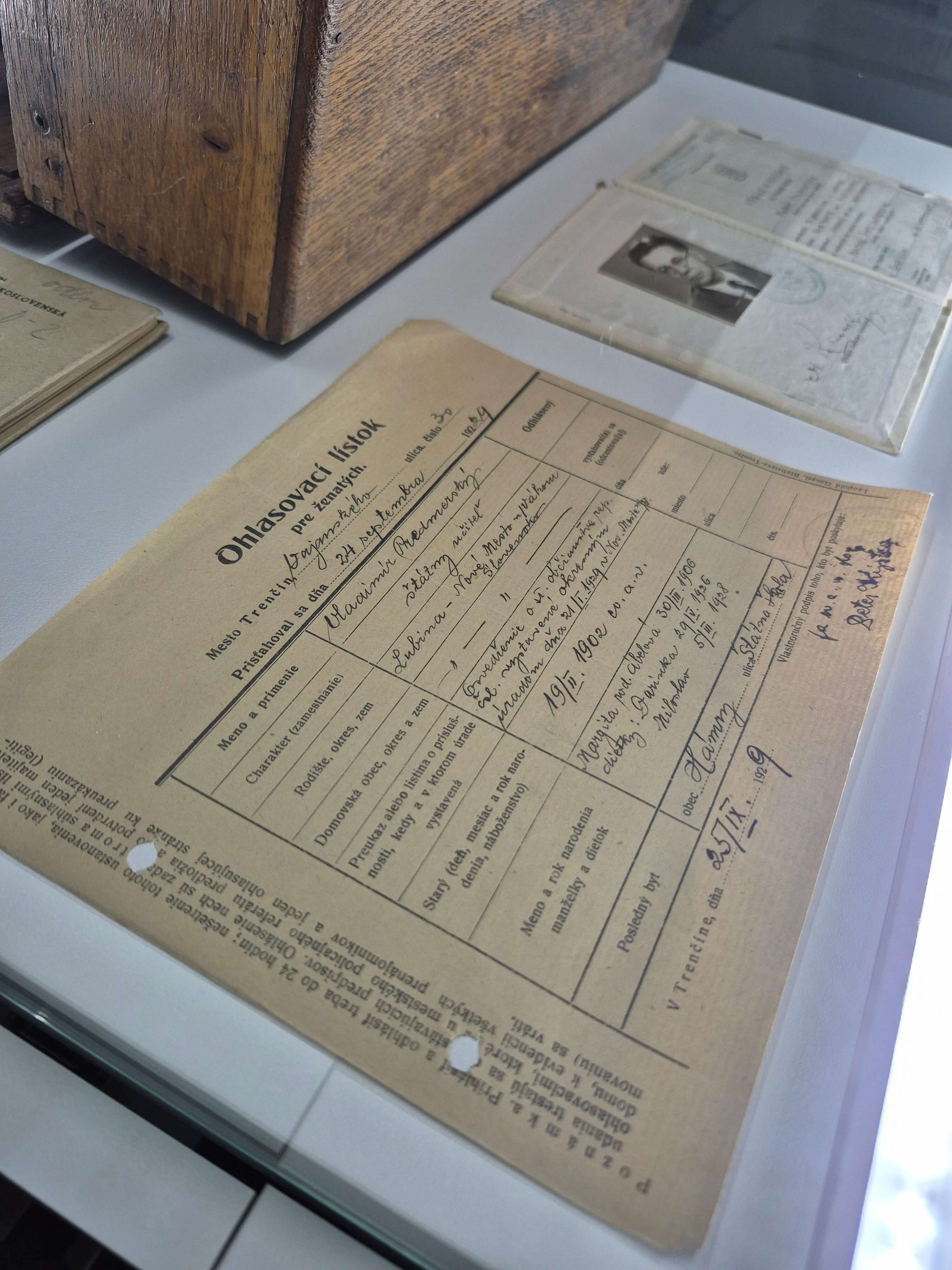
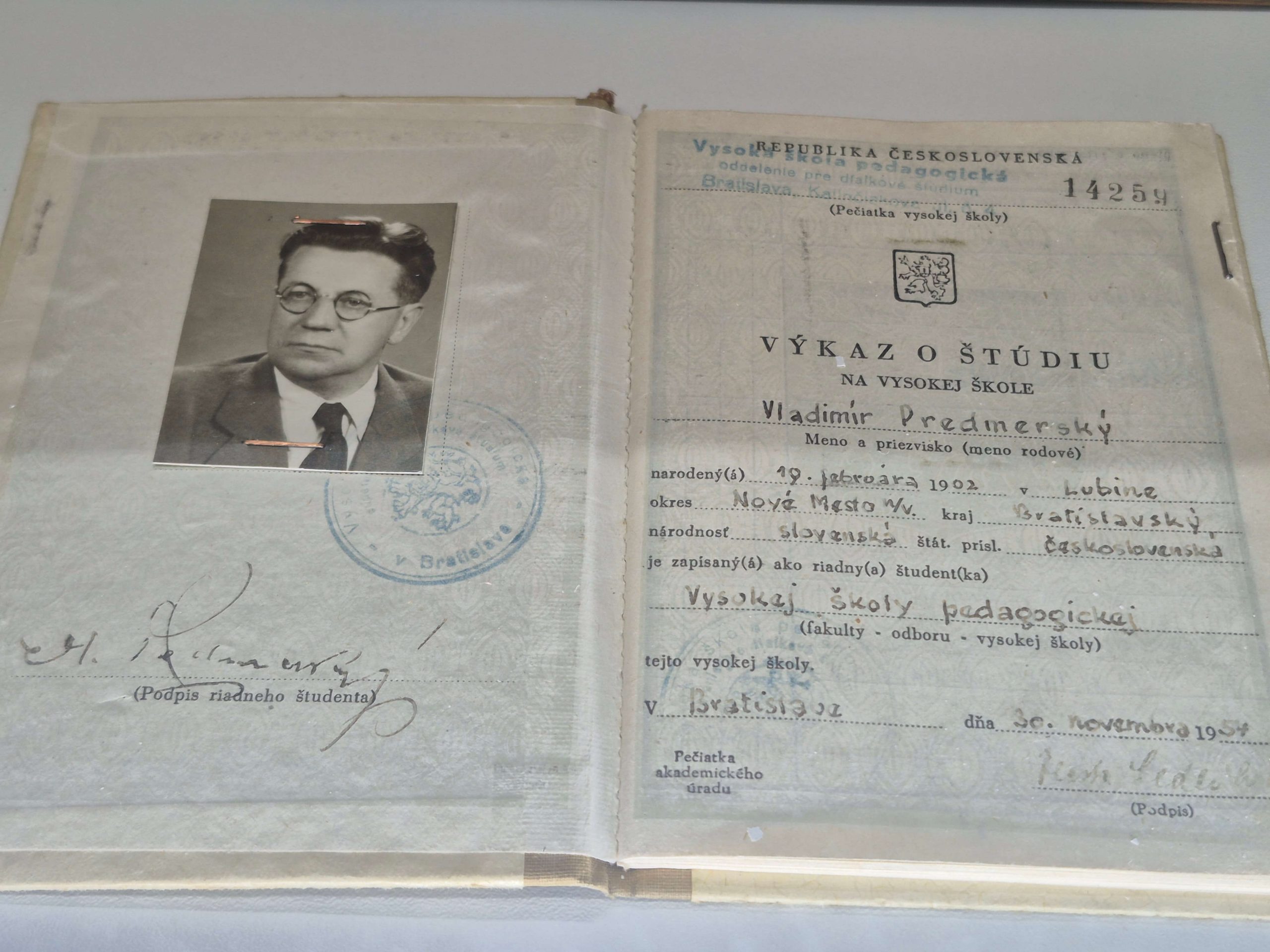
Sample of personal documents of Vladimír Predmerský
The most interesting and rare personal documents of Vladimír Predmerský, donated to the museum by his daughter, MUDr. Nadežda Blahutová, including the Marriage Registration Card from 1929 and university indexes from 1954/55.
Curriculum vitae
Vladimír Predmerský was born on February 19, 1902, in Lubin near Nové Mesto nad Váhom, as the 14th child of his parents: teacher Albert Predmerský and Pavlína, née Trančíková. He graduated from elementary school, middle school, and the Teachers’ Institute in Marmošská Sihot and Modra.
He tried his hand at teaching as an itinerant teacher in Drietoma, Hámry, Moravský Lieskov, Vrbovce, and Chvojnica, where he taught the so-called Rimavčátá, state orphans who went to school to rest after hard physical work, which had a very negative, intimidating, and even desperate effect on the young, ambitious teacher. It was in this environment that he first met epileptics and children with various disabilities and specific educational needs.
On August 10, 1925, he married Margita Ábelová, with whom they raised two sons – Miloš and Vladimír and two daughters – Darina and Nadežda.
In 1929, he acquired qualifications for all types of special schools by passing the special pedagogy exam at the Ministry of Education in Prague. From September 1, 1929, he planted deep roots in the State Folk School in Trenčín, where he intensively prepared the opening of a special class for students with disabilities.
The State Auxiliary School in Trenčín was established by decree of the Ministry of Education and National Enlightenment No. 131.065/30 of October 21, 1930.
Classes with 19 students began on December 1, 1930, in a building on St. Anne’s Square.
In the 1931/32 school year, the school had only 2 classes, which educated 24 students.
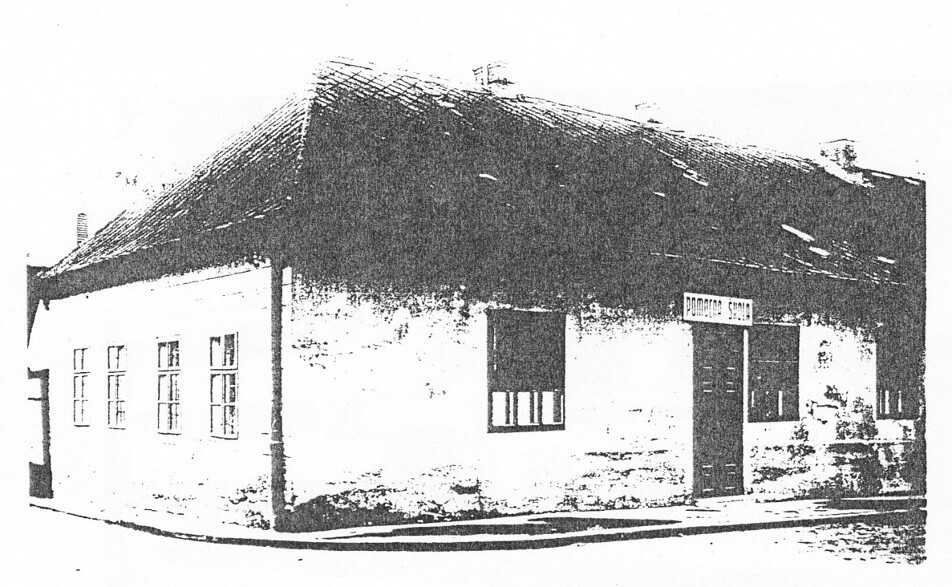
State Auxiliary School in Trenčín on St. Anne’s Square, 1 December 1930
In the following years, 1930-1936, Predmerský acquired professional teaching qualifications to teach deaf, blind, and physically disabled children. By acquiring professional and especially practical skills, he accumulated an incredible amount of knowledge, which he transformed into practice and solved educational problems in the auxiliary school.
The further development of the school was linked to the establishment of the Provincial Association for the Care of the Weak-Minded in Slovakia. I quote Vladimír Predmerský:
“It was bitterly cold when, on January 12, 1932, voluntary social workers gathered at the Folkman Hotel in Žilina to lay the foundations of the Provincial Association for the Care of the Weak-Minded in Slovakia in the presence of the masters of the care of the feeble-minded – Prof. MUDr. Karol Herfort and Ministerial Inspector Josef Zeman.”
Of course, Vladimír Predmerský, then a professional teacher at the State Auxiliary Class in Trenčín, was also present.
The personalities of the care of the mentally handicapped in Czechoslovakia at that time – the aforementioned Dr. Herfort, J. Zeman, V. Gaňo, V. Predmerský and others unanimously stated that the area of care for the mentally handicapped is one of the most neglected areas of social care and that it is necessary to establish a proper voluntary organization that would promote systematic care for thousands of the mentally handicapped in Slovakia.
On January 12, 1932, they founded the Provincial Association for the Care of the Mentally Handicapped in Slovakia, with its headquarters in Trenčín.
Viliam Gaňo, director of the Institute for the Deaf and Dumb in Kremnica, was appointed the first chairman of the association, Vladimír Predmerský, a specialist teacher at the State Auxiliary Class in Trenčín, became the secretary, and František Tomiška, a specialist teacher of the deaf and dumb in Kremnica, became the treasurer.
Despite the existing auxiliary schools in Spišská Nová Ves (1924) and Košice (1925), the situation was unbearable, and there was a lack not only of schools/institutions, but especially boarding houses for the huge number of children with mental disabilities.
In the 1933/34 school year, only 2 classes were still operating in Trenčín, in which 42 pupils were already educated.
And since the number of people interested in institutional care was constantly growing, the committee of the Provincial Association for the Care of the Weak-Minded in Slovakia, at a meeting on September 23, 1933, at the proposal of the association’s secretary, Vladimír Predmerský, established a construction committee for the construction of an institution for the mentally defective in Trenčín. Based on official permission, the construction committee began organizing a financial collection in the form of building bricks.
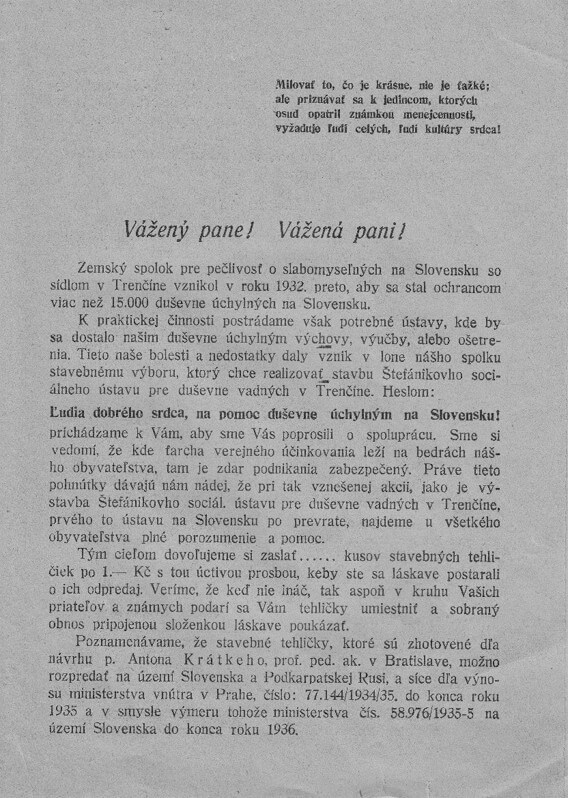
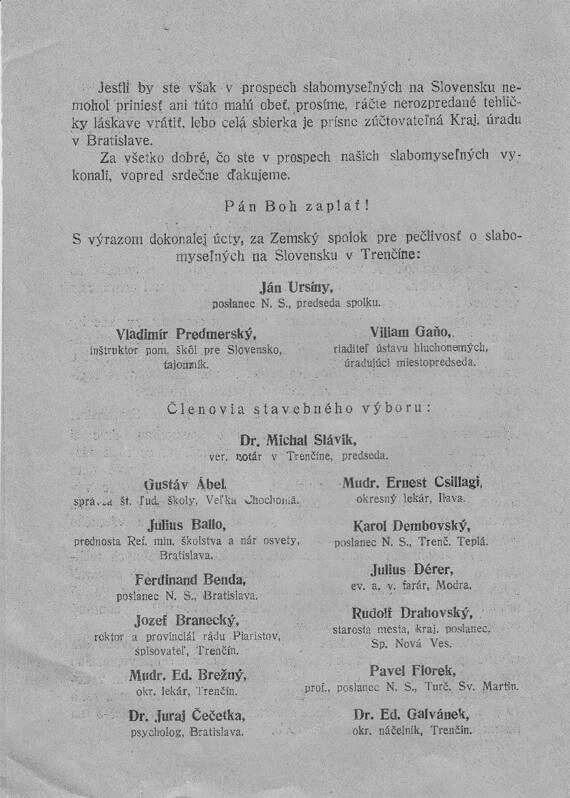
The text of the Tehlička support appeal letter for the construction of the Štefánik Social Institute for the Mentally Disabled in Trenčín, which addressed potential donors not only in Slovakia, but also in Subcarpathian Ruthenia
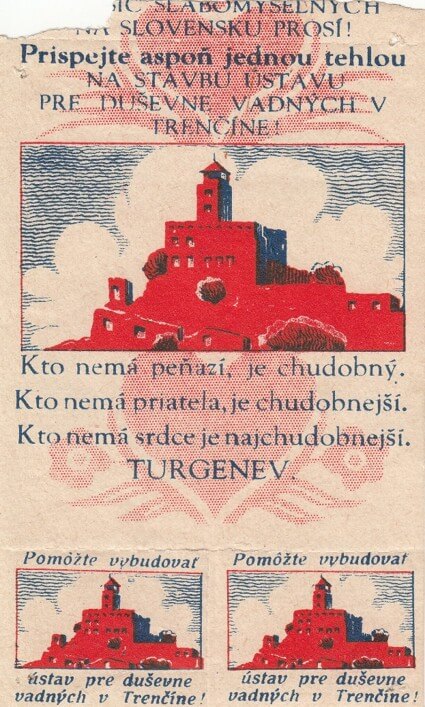
Sample of Tehlička’s support call for the construction of the Štefánik Social Institute for the Mentally Disabled
In accordance with the resolution of the Provincial Association Committee dated 17. 2. 1934 – the association rented the building of the former epidemiological hospital at Soblahovská Street No. 22 from the city of Trenčín and established a boarding house of the State Auxiliary School there, into which the first 10 boarding school students moved on 16 September 1934.
In the school year 1935/36, the school already had 4 classes with 65 students, of which 31 children were in the boarding house.
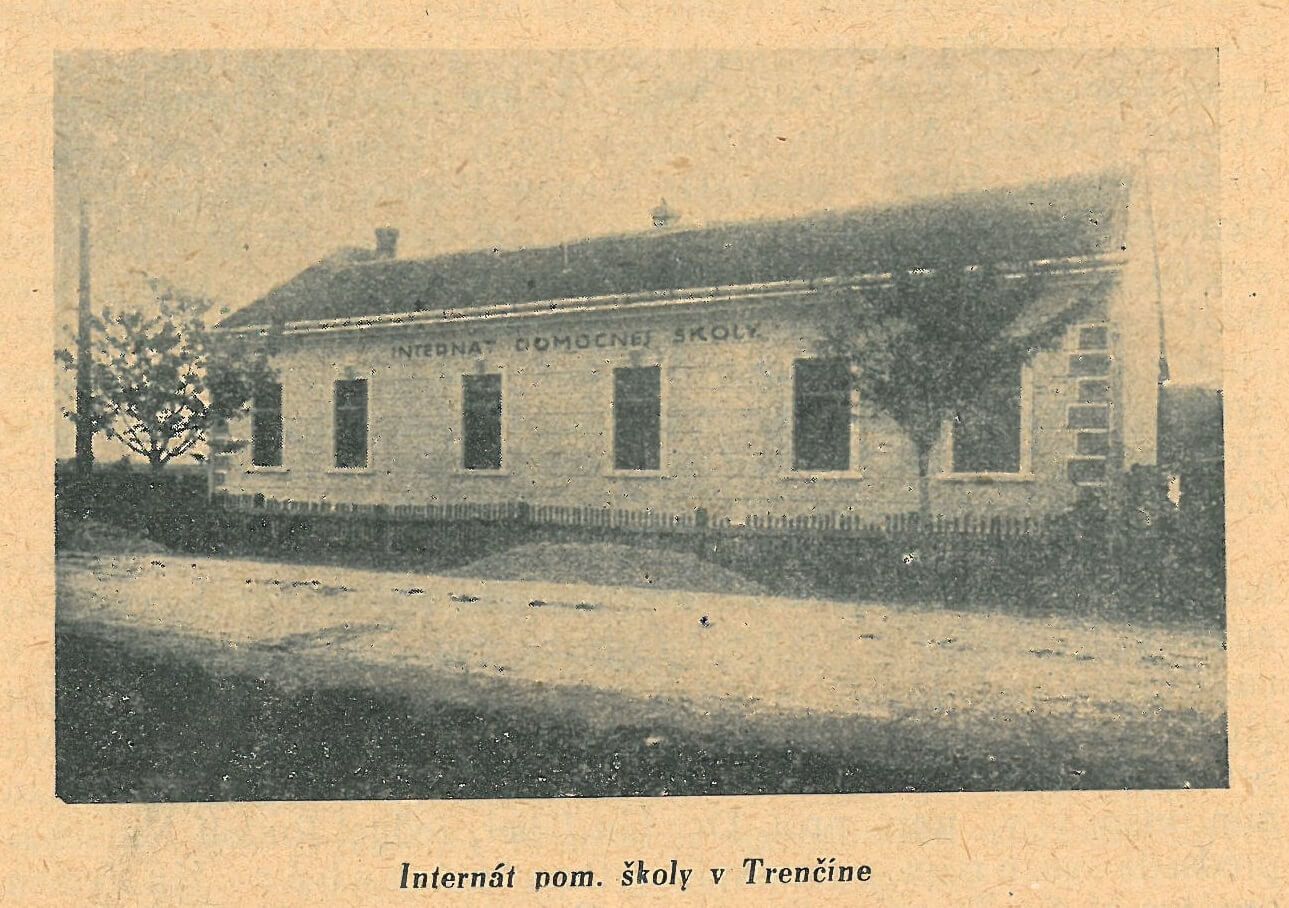
The first dormitory of the State Auxiliary School in Trenčín, at Soblahovská Street 22
With the Golden Brick Support Campaign, the association secured the financial basis for the construction of a new school. Construction began on September 21, 1938, and the new building was put into use in less than 16 months, on January 1, 1940. The construction budget at that time amounted to an incredible 1 million CZK.
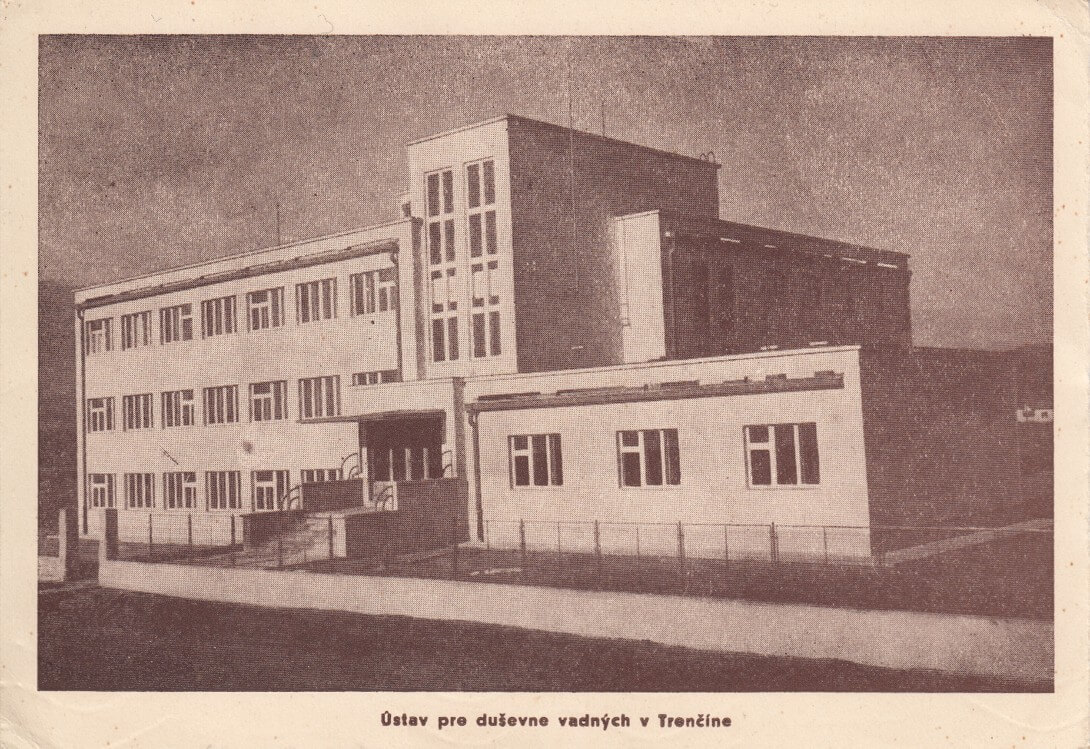
The new building of the Institute for the Mentally Defective in Trenčín, opened for use on January 1, 1940
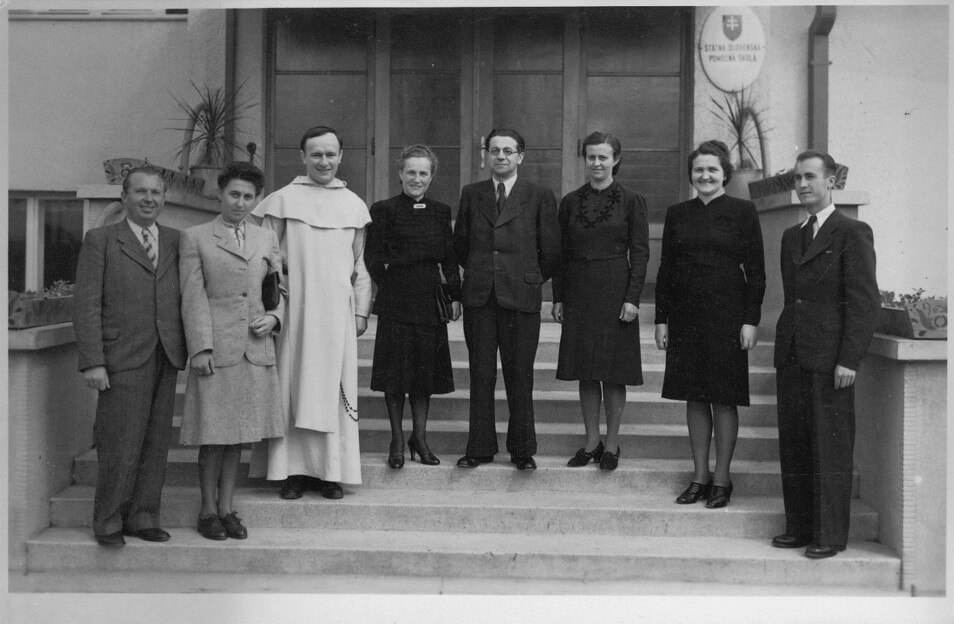
The teaching staff after the opening of the Institute for the Mentally Impaired in Trenčín, January 1, 1940. Vladimír Predmerský in the middle
Until 1938, Predmerský was a member of the presidency of the Association of Teachers of Auxiliary Schools in Slovakia and Czechoslovakia. In the years 1945-1954, he headed the Cabinet of Defectology of the Bratislava Region. In 1954, he permanently ended his work at the current United Boarding School in Trenčín, already in the position of director, and took up the position of central inspector at the Education and Culture Commission in Bratislava (until 1961). During those years, he also lectured to external students of defectology.
His extensive publishing activity is associated with the professional periodicals Špecialna škola and Otázky defectológie, in which he also actively worked as a member of the editorial board.
In 1959, he completed his studies in pedagogy and psychology at the Pedagogical University in Bratislava, and in 1961, he joined the department for the education of defective youth at the Pedagogical Research Institute in Bratislava.
Vladimír Predmerský is also associated with the establishment of a university study of special and therapeutic pedagogy. Since 1965, with other important figures – e.g., doc. Bažány, prof. Brťek, they have been preparing the Concept of the Study of Special and Therapeutic Pedagogy, which was achieved in the 1967/68 school year, with the establishment of the Institute for Special and Therapeutic Pedagogy and the opening of an internal university study.
Vladimír Predmerský was appointed Head of the Department of Special Pedagogy at the Institute of Special and Therapeutic Pedagogy, Faculty of Arts, Comenius University in 1967. In the following year, 1968, after successfully defending his dissertation, the Scientific Council of Comenius University’s Faculty of Arts awarded him the scientific rank of Candidate of Pedagogical Sciences. In 1971, based on his successful habilitation, he was appointed by the Scientific Council of the Faculty of Arts, Comenius University, as the first associate professor of special education in Slovakia, and at the same time graduated with a doctorate in philosophy.
Associate Professor Predmerský was a member of the Scientific Council of the Faculty of Arts, Comenius University, a member of the Research Institute of Child Psychology and Pathopsychology, the founder and first chairman of the Society for Special and Therapeutic Education in Slovakia (1969), and the head of its historical and documentation center.
At his initiative on March 1, 1981, the Museum of Special Education in Levoča was established on November 16, 1990.
Publication activity
It is almost unthinkable that one person, whose day lasts only 24 hours, just like each of us, would leave behind such a huge library of professional literature – more than 264 titles – monographs, professional articles, university scripts, studies, reviews, in which he focused on the problems of psychology, solving issues of upbringing and education of mentally disabled children, etc.
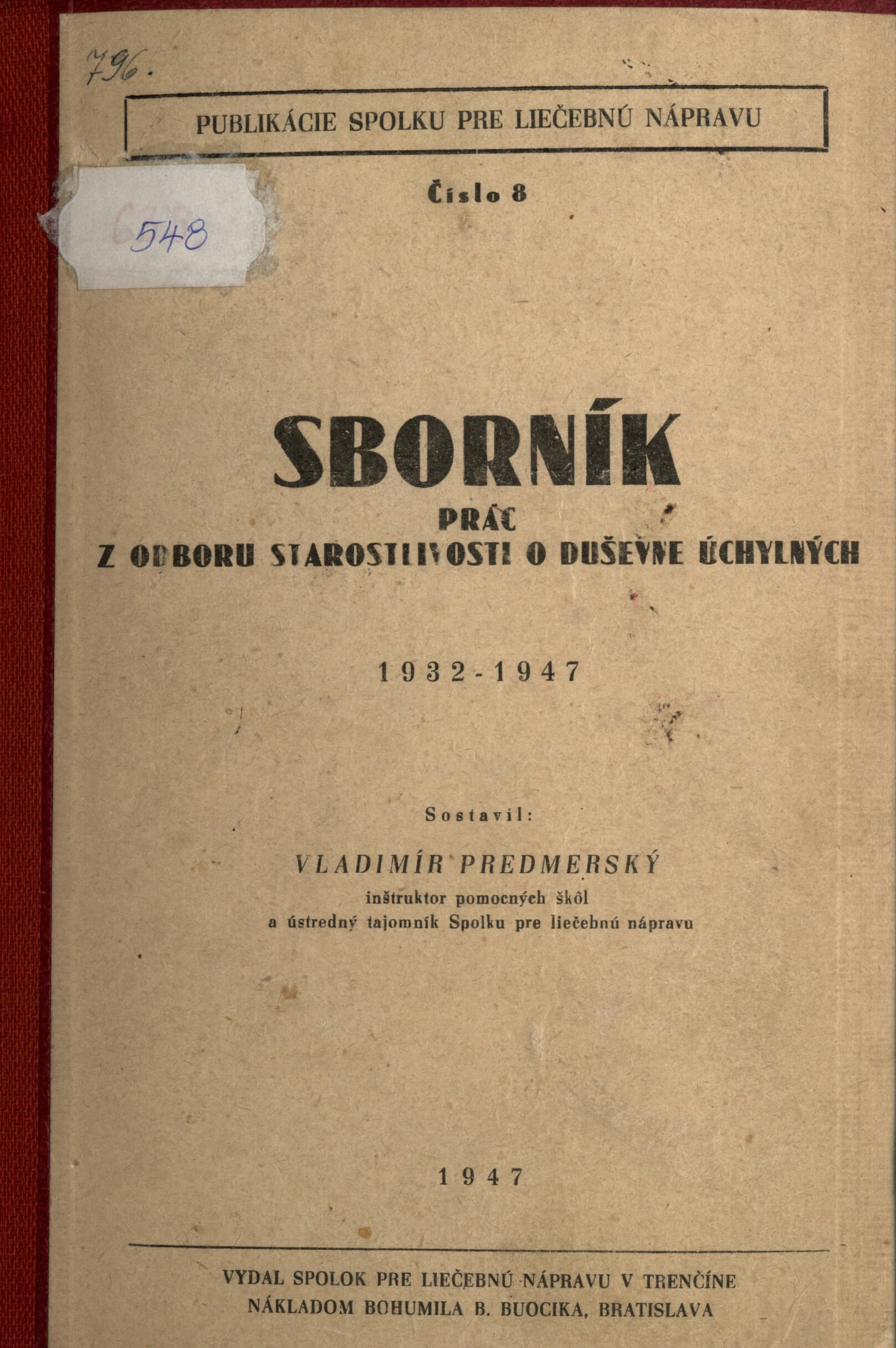
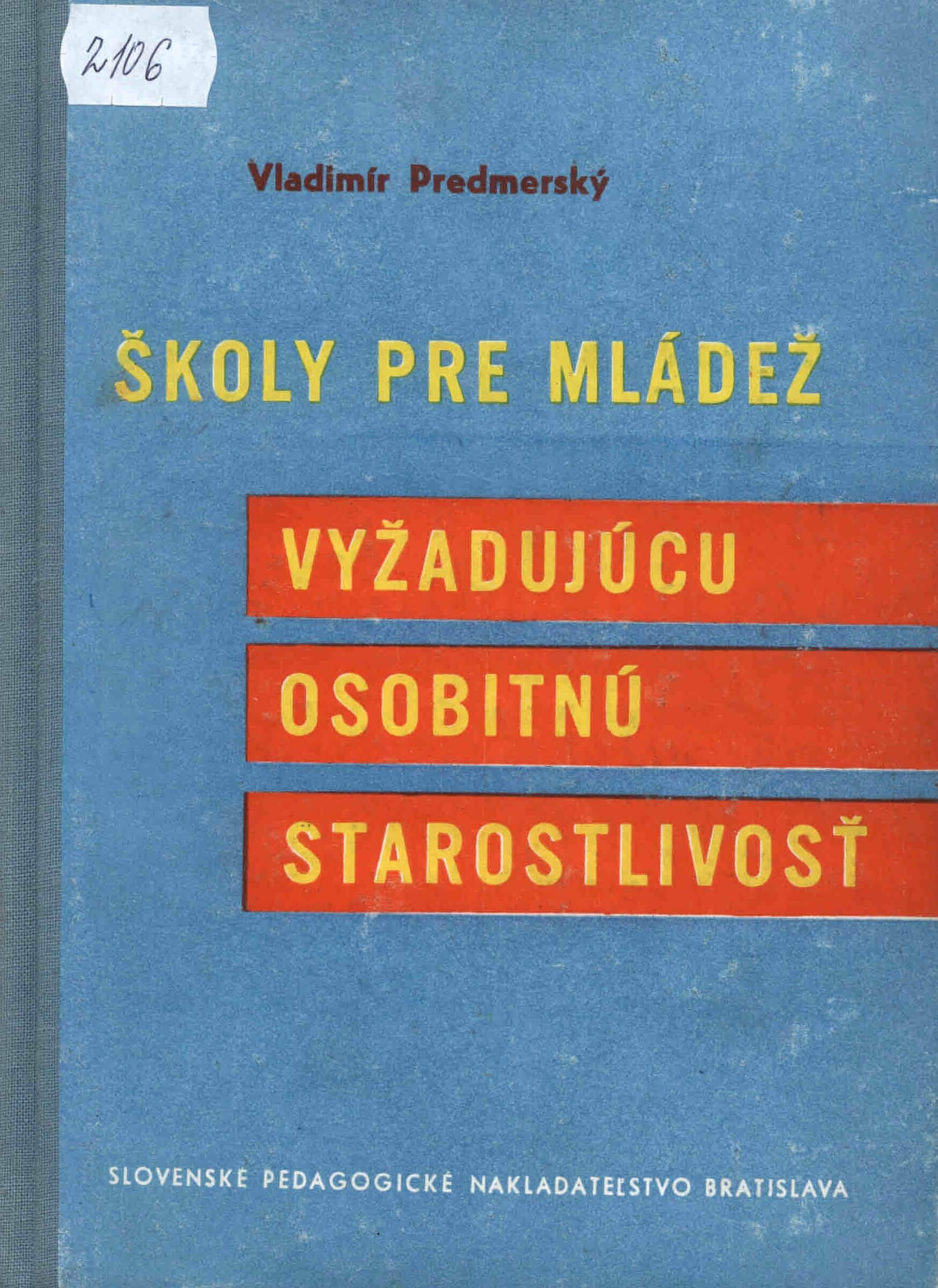
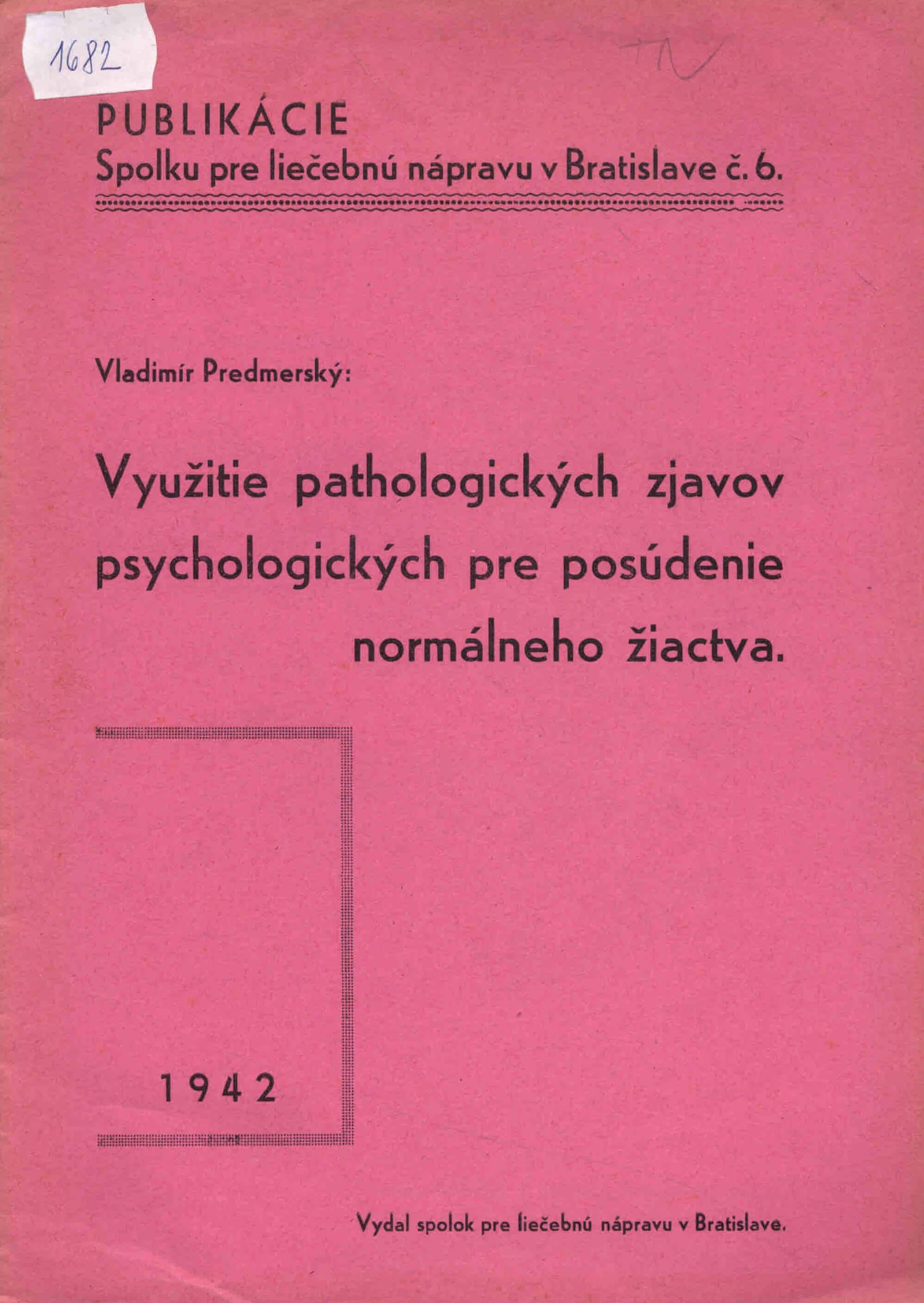
Sample of the title pages of the publications of doc. Predmerský. All titles are digitized and published in the Digital Library on the museum’s website.
Awards given to Vladimír Predmerský
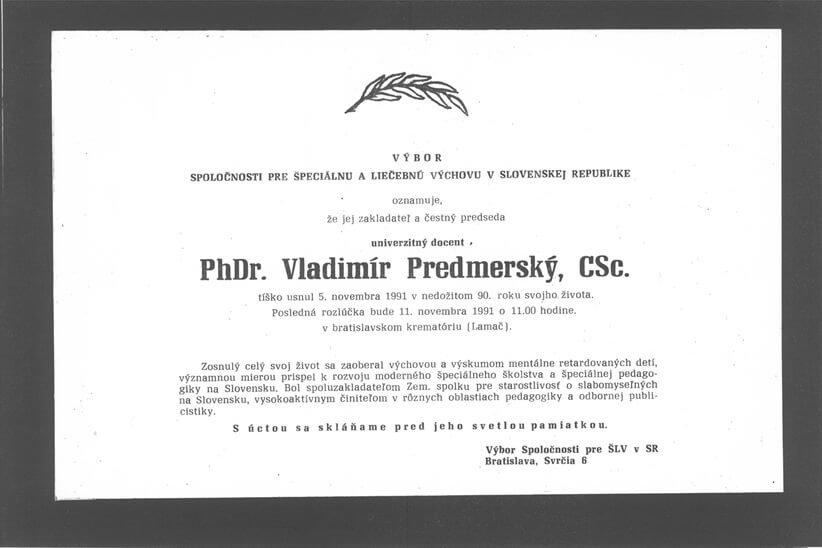
During his lifetime, he was awarded the following awards:
Distinguished Teacher (1957)
Ján Amos Comenius Medal (1982)
and the Gold Medal of the Faculty of Education, Comenius University, in memoriam (2007).
Prepared by: Mgr. Štefánia Petreková
Source:
Example of Vladimír Predmerský’s personal documents. Source: Museum photo archive
State auxiliary school in Trenčín on St. Anne’s Square, 1 December 1930. Source: Museum collection – Predmerský, Vladimír: Collection of works from the department of care for the mentally retarded 1932–1947.
Example of Tehlička’s support appeal for the construction of the Štefánik Social Institute for the Mentally Defective. Source: Photo archive of Branislav Horňák, son of Darina Predmerská’s daughter
Text of the letter of Tehlička’s support appeal for the construction of the Štefánik Social Institute for the Mentally Defective in Trenčín, with which they addressed potential donors not only in Slovakia, but also in Subcarpathian Ruthenia. Source: Photo archive of Branislav Horňák, son of Darina Predmerská’s daughter
The first boarding school of the State Auxiliary School in Trenčín, at Soblahovská Street 22. Source: Museum Collection – Predmerský, Vladimír: Collection of works from the department of care for the mentally retarded 1932–1947.
The new building of the Institute for the Mentally Defective in Trenčín, put into use on 1 January 1940. Source: Museum Collection
The teaching staff after the opening of the Institute for the Mentally Defective in Trenčín, 1 January 1940. Vladimír Predmerský in the middle. Source: Photo archive of Branislav Horňák, son of Darina Predmerská’s daughter
Example of the title pages of publications by doc. Predmerský. All titles are digitized and published in the Digital Library on the museum’s website. Source: Museum Collection